Maths DLO – How to add fractions

For this task we learnt about adding fractions. In order to add them up properly we all keep the denominator the same and never add it up, the only thing that we will be adding is the numerator. You will also be requiring addition and multiplication to answer these questions.

I enjoyed this activity because we get to use a combination of addition and multiplication!

Tongan Language Week – Maths

For maths, my group and I structured word problems that has a connection with the Tongan Language Week. There are 7 slides and 10 questions in total to answer, and we make sure the questions are Tongan Language Week related. The following questions followed includes subtracting, addition, division and multiplication.

Something I found interesting about this task is how we decided to make up the questions using our knowledge.

Triangle angles


All of the triangle angles are all added up to 180 degrees no matter what type of triangle they are. All of them has to always be the same number/degrees when you add them up altogether inside the triangle. More explanation and examples are on the image.

I found this activity confusing but educating at the same time because I am explaining what the angles are of a triangle and learning more about it.

Addition algorithm


Addition algorithm is the opposite of Subtraction algorithm since addition is adding up the numbers and subtraction is taking away the numbers away, Which makes addition the opposite of subtraction. I explained more of how addition algorithm works, please check it out.

I found this activity education because I’m explaining/teaching how addition algorithm works in my DLO.

Subtraction algorithm


We first start off by making a DLO for our maths and putting it in the Google slides. I did Subtraction algorithm which is the opposite of addition , and explained how it worked and solved in my DLO and it is pretty easy to solve, just ignore of how high the number is and calculate what the answer is. The explanation is right ontop of this text.

I found this activity educating because I am explaining how Subtraction algorithm works.

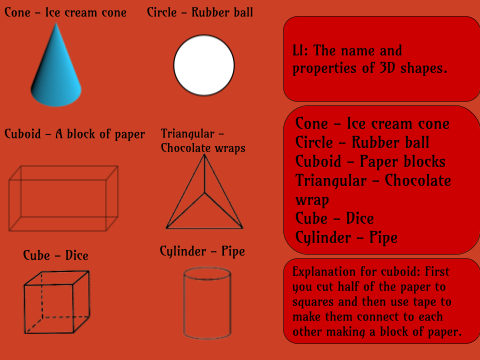
The name and properties of 3D shapes


First off in the lesson we do the Maths strands which is different from the Maths we usually do. But first, the lesson starts off with our teacher showing us a video of 3D and 2D shapes which also includes their names. Once after the video is done we pressed a link leading us to 3D and 2D shapes images also shows us to answer on how many edges and corners they have. And including naming the all the shapes in our Maths (strand) book. After we’ve all done that, we do a DLO called “The name and properties of 3D shapes” if you don’t get what were supposed to do in the DLO, we first need to pick 6 3D shapes to put in the DLO. After finishing on picking the 6 3D shapes we name all the shapes we pick that is used in everyday life. The DLO is on top of this text.

I found this activity pretty cool and interesting because we did some drawing in our Maths (strand) book, about 3D shapes and 2D shapes and their corners, edges, and lastly names.

Hello world!

Welcome to your brand new blog – a space to share your learning journey.

To get started, simply visit your blog’s dashboard, edit or delete this post and check out all the other options available to you.

Like more help?

We can walk you through step-by-step in our guide to getting started with your blog.

You can see what other learners are sharing on their blogs here.

Happy blogging!